
Simulating the Nord Stream Blasts
with me and my AI assistant, Claude

Decades ago I could sit day and night in front of the computer, trying to get a program to work and solve a hard problem with mathematical algorithms. Then I got access to a big team of very skilled developers, and I could talk to them and persuade them to implement things I wouldn’t be able to do myself. I look back at those times as a highlight of my life. The interaction with people more skilled than myself was exciting, I learned a lot, and seeing people appreciate the resulting product was wonderful.
As a retired 65 year old engineer, I never though I’d experience this feeling again. But I just did. For the past two weeks I’ve been addicted to the new paradigm of AI programming using the English language as the only means of interacting with the coding agent. I’m using Claude Opus 4.6 from Anthropic, but I’ve heard GPT 5.3 Codex from OpenAI is a valid alternative. There is competition and a breathtaking pace of evolution.
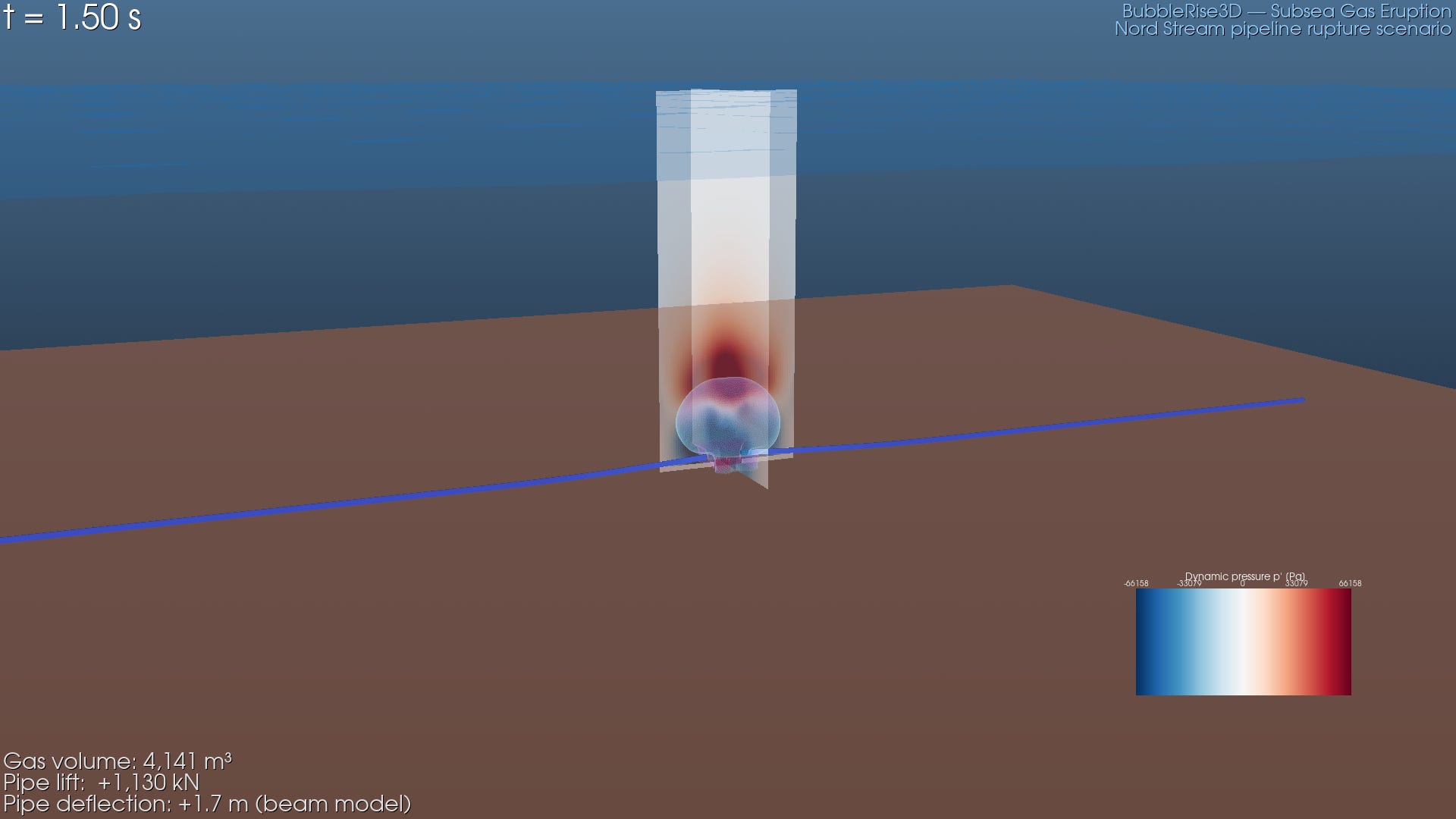
I started using Claude with moderate expectations, but ended up asking it to build 3D structural mechanics and fluid dynamics models to simulate the full sequence of events from the bomb explosion breaking the pipeline, the rise of the huge bubbles and updraft of the pipe, followed by the “loose garden hose” dynamic of the broken pipeline and the cascading of ruptures.
My first modest goal was to improve a Matlab program I had “hand programmed” (a thing of the past), to simulate the blowdown process when the gas was vented out of the pipelines after the blast. My model had a good match to the pressure drop data I had obtained in a FOIA request, but it wasn’t perfect. Now I’m expecting higher resolution data soon, and I wanted to fix the remaining kinks. Claude quickly pointed out I’d made an error in applying partial derivatives on some gas constants which turned into functions when using real rather than ideal gas properties. Then he helped me model transient heat transfer to the pipe walls. The result was a perfect match to the real measured data, and that’s when I realized Claude was serious. I was still in a domain which I knew, and asked Claude for things I could have done “by hand”, but it had taken me months to get it right. Modeling real “yamal mix” natural gas properties in large interpolation tables is just hard work, and very similar to things I’ve been sweating over in other projects, so I could appreciate how much labour Claude was saving me. Next I cloned a program for seismic airgun simulation from Eric Dunham’s homepage at Stanford and gave it the same treatment. Claude converted form Matlab to C and tried an acoustic airgun with Nord Stream dimensions and real natural gas properties. In just 15 minutes I had figured out that the acoustic energy generated by a real natural gas bubble was more than twice that of air. At that point I decided to let Claude have a go at larger simulation projects from scratch.
I asked Claude, is there anything Abacus can do that you can’t do for me? Abacus is a large and expensive Finite Element Analysis software which people use to simulate the mechanical strength of materials and how they break when you stress them over the limit. Claude answered with confidence, “there’s a huge penalty to generality”. "Writing a program from scratch around a specific geometry can give better results. I really think Claude has an important point here, and I predict the death of these general packages.
I have written about the observations of deformed pipeline fragments on the Baltic sea floor, so the obvious first question for me to ask Claude is what size, type and placement of bomb would generate the exact deformations we observed. After telling Claude about the pipeline geometry and properties, I asked him to find the bomb details that would produce the damage we had observed. Claude started with a 3D FEM model and keeps refining it, details about crack propagation speed are checked against published literature, steel properties like “anisotrophy” and “triaxiality” are modelled, and Claude goes on to make parametric studies until the exact same simulation program reproduces the result at two very different internal pressures.
(Video above simulates the explosion at Nord Stream 2, string A which happened 17 hours after the first explosion on the same string. Pressure had decreased to 35bars and catastrophic opening did not occur. Compare with the video before which simulates the first explosion on the same pipe, 79km downstream)
An Euler solver was added to model the shock wave in the gas inside the pipeline. After a longitudinal crack travels at 200 m/s along the pipeline until the crack suddenly turns in a circumferential direction and the wall opens like saloon doors at supersonic speed (1000 meters/second). All this happens in the first milliseconds after the blast and inside a bubble of reaction gases (not shown here). The natural gas rushing out from the opened pipeline fills and continues to expand the bubble walls in the water, and the rise of this bubble generates an enormous updraft.
The gas flows at sonic speed through the open ends of the pipeline, and as the pressure gradient and water flow under the bubble lifts the ends of the pipeline. Initially, 20,4 tonnes of natural gas flows at 300 meters per second through the last sections of pipeline, as that flow gets in the bend, the so called “garden hose forces” come in play, working against the updraft forces of the rising bubbles, they break the pipe in pieces. Claude finally got this to work after almost two weeks of arguments with me. It proved to be much more challenging than the 3D Navier-Stokes multigrid simulation to compute the updraft, which Claude managed in less than an hour.
The Nord Stream pipeline is a rather stiff and heavy garden hose. The 26.8 mm steel is covered by 10cm reinforced concrete giving an outer diameter of 1.4 meters. 12.2 meter long sections are welded together at 60cm wide joints which are only covered by soft polyurethane foam giving no structural strength. As the steel pipe bends at the joints it “ovalizes” and cracks the concrete. Claude had to dig deep into literature on buckling and what actually happens when you bend a pipe. That process slowed down the cascading, and arrested it after some 140 meters, when the gas flow forces had declined to a small fraction of the original strength. You can see the forces in the charts below the animation. Note the cooling of the steel due to adiabatic gas expansion. It lowers the failure threshold, and created the characteristic brittle fractures observed. 282 and 249 meters of pipe got demolished in the two 165bar Nord Stream 1 strings respectively, so 130-140 meters on each side of the initial blast were destroyed. The curling of the broken off pieces is just a schematic. In reality the broken off pieces are pushed off dramatically by the gas jet and uplifted by the plume currents. That’s for future version. My main takeaway from this was that the pipeline is actually stable with respect to the garden hose forces. It’s the plume driven updraft that starts the cascading and is crucial to keep it going, although the internal gas forces help with the extra push to actually break the pipe.
I want to keep this text short, as it is what it is, just a first impressions account of me using and AI programming assistant to simulate some fascinating physics. If I tried to do more it wouldn’t age well I guess, because this technology is evolving super fast.
I did it partly to prepare for the upcoming trial in Germany of a alleged Nord Stream bomber Serhii Kuzniezov. According to German law, all evidence is required to be made public, and we’re still missing any evidence which ties the accused to the actual crime scene. Der Spiegel has published details about the bombs the Ukrainian divers were supposedly using. According to Spiegel, a retired bomb expert called “Opa” (grandpa in German) turned dive bottles into linear cutting charges by dividing the interior into two chambers, one to be filled with explosives and the other with the materials to make it into a cutting charge. 2kg of a proper cutting charge would have been enough to break the pipeline, but the deformation of the depressurized pipeline points to a 25kg omnidirectional charge or a 12 kg directed charge. Maybe that’s what Opa did, but then there is plenty of evidence for that collected by the investigators on the seafloor. Fragments of the dive bottles pushed into the concrete, and such things. If they can’t show that, the theory the the sailboat trip was a cover operation and the military did the real job in the background will stay alive.
Nice job! AI can help solve intricate, complex problems, provided you possess the required knowledge and skills in a particular subject matter, so you can ask and correctly formulate the right questions. Andersson's article is a great illustration of that.
Wow. Interesting stuff to read even as a non-engineer (I started as math major but ended up as Phonetician)
What seems pretty apparent to someone like me is that the Ukrainian story is nothing but a pipe dream (excuse the pun).
There is no way these guys pulled this off and what it really appears to be is a scapegoat trial to save the German Chancellor's office from scrutiny and shame of colluding with US to destroy the energy lifeline of Germany to go along with US Imperialism and try to undermine Russia.
But hey.. maybe that is just another pipe dream.. of a different kind..